



Would you pray for me? I’ve included a few prayer requests after the post. Thanks!
What if one disastrous idea lies behind the emptiness of modern life—but few had noticed?
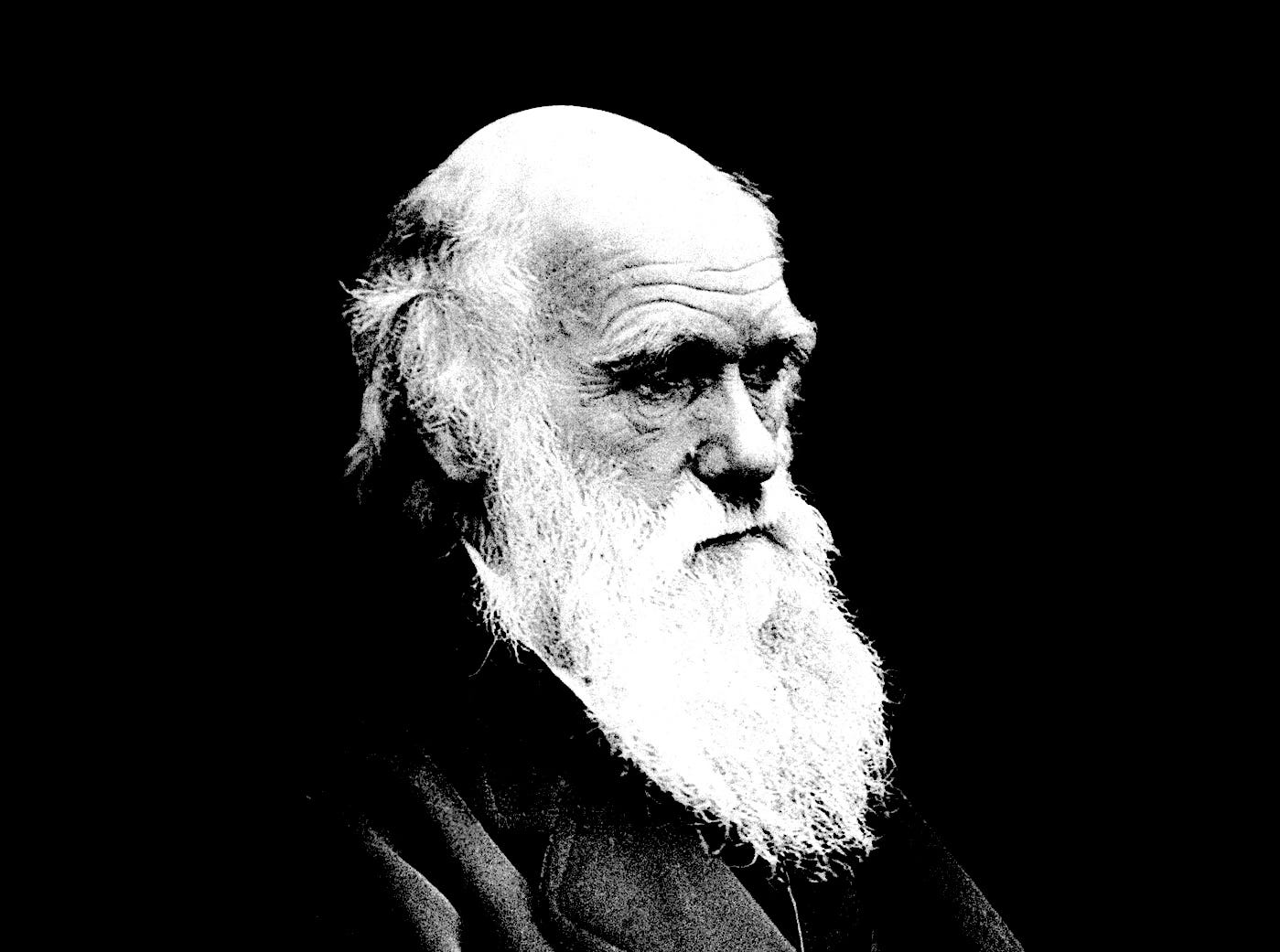
With his book, On the Origin of Species1, Charles Darwin achieved the 1859 version of going viral. The original 1,250 printed copies sold out the first day. A firestorm that spanned scientific, religious, and philosophical circles had begun.
By means of what he called “natural selection,” Darwin proposed that biological life, in all its complexity and variety, had emerged as the result of blind chance. He understood the theological implications of his theory and wrestled with this personally. As he wrote to biologist Asa Gray in 18602,
This is always painful to me. . .I had no intention to write atheistically. But I own that I cannot see, as others plainly do, & as I should wish to do, evidence of design and beneficence. . .
I see no necessity in the belief that the eye was expressly designed. On the other hand I cannot anyhow be contented to view this wonderful universe & especially the nature of man, & to conclude that everything is the result of brute force.
I am inclined to look at everything as resulting from designed laws, with the details, whether good or bad, left to the working out of what we may call chance. Not that this notion at all satisfies me.3
Darwin wanted to believe that life had resulted from both “designed laws” and, somehow, by “what we may call chance.” But, as he admitted, he wasn’t satisfied with this fusion. He knew it was logically contradictory.
In her book Total Truth, Nancey Pearcey zeroes in on what’s at stake: “If the world itself was not designed, then there can be no design or purpose for human life either.” She quotes historian Jacques Barzun, who describes the modern controversy over Darwinism4 as one particular skirmish between “the believers in purpose and the believers in mere chance.”
The believers in purpose and the believers in mere chance.
We might be convinced our feelings, opinions, and choices matter. But in a universe that’s the result of mere chance, they can’t. They’re nothing more than fleeting perceptions in a cold, pointless universe.
It would follow that compassion is an illusion. Self-sacrifice would be the height of foolishness. Any human aspiration beyond passing our genes on to the next generation would be utterly without purpose—and one could question whether even that would have meaning. What, after all, could be the greater purpose of perpetuating a meaningless species?
The bleak moral logic that Darwinism yields is too often overlooked. One major reason for this is that few Darwinists live by convictions that are consistent with their first principles. As a modern example of this, Pearcey points to Robert Wright, author of the evolutionary psychology book The Moral Animal. In it, Wright states, “We believe the things—about morality, personal worth, even objective truth—that lead to behaviors that get our genes into the next generation.” In other words, what we call “truth” is really just a means to an end, a useful fiction. Yet, later in the same book, Wright claims we need to “correct the moral biases built into us by natural selection” and practice “brotherly love.”5
Wright’s mental gymnastics may seem obviously flawed to Christians, but it pinpoints the worldview collision that has been roiling the West for over 150 years. It’s a clash between purpose and chance, the latter usually followed by a desperate attempt to recover a sense of purpose.
So, as “believers in purpose,” did Christians unite against the emptiness of “mere chance”? Not according to Pearcey.
The bitterest debates [involving Christians] were often not with atheistic evolutionists but among believers with conflicting scientific views: young earth creationists, old-earth creationists, flood geologists, progressive creationists, “gap” theorists, and theistic evolutionists. . .
Meanwhile, secularists were happy to fan the flames. As [Intelligent Design proponent] Phillip Johnson once put it, “They all but said, ‘Let us hold your coats while you fight.’” For if Christians were going to endlessly divide, then it was clear that secularists would conquer.6
And conquer they did.
It’s hard for us today to appreciate how massive a shift Darwin’s ideas unleashed in Western intellectual life. There were certainly skeptics of Christianity in academia before Darwin. Philosophers like Thomas Hobbes (1588–1679) and David Hume (1711–1776), for example, had already challenged some religious assumptions. But their influence was limited by the fact that they didn’t have an all-encompassing idea in which to ground their skepticism. They could snip at branches of Christian thought, but they couldn’t uproot the whole tree.
And then, in 1859, that changed.
Now, after more than 150 years of Darwinism, Robert Wright can breathlessly argue that all truth claims “are, by Darwinian lights, raw power struggles.”
If that sounds familiar, it’s because ideas like this have overwhelmed colleges and universities. This notion of power struggle now shows up in fields ranging from economics to sexuality. It’s unknown whether Darwin would have agreed with his concepts being used this way. But ideas often take on a life and force all their own.
Of course, humans can’t thrive without meaning. And as Robert Wright revealed with his yearning for “brotherly love,” we can’t help but seek a higher purpose. We may be living in a moment when ideologies built atop the emptiness of “mere chance” are revealing their weakness. This is a hopeful possibility, and one I intend to take up in a future post.
In the meantime, fill your minds with the true, the good, and the eternal. Abide in the words of Philippians 4:8:
Finally, brothers, whatever is true, whatever is honorable, whatever is just, whatever is pure, whatever is lovely, whatever is commendable, if there is any excellence, if there is anything worthy of praise, think about these things.
Prayer Requests
I probably should have asked for your prayer sooner. Not because I’m going through anything unusually difficult, but because every worthwhile thing we do needs the support of prayer.
Since writing is how I connect with you, I’d especially appreciate prayer related to that. Feel free to expand on these requests and pray as the Lord leads you.
Please pray that the words I write would help people to grow in their walk with God. (If that isn’t happening, I should put my efforts elsewhere!)
Please pray that the Lord would help everyone He’d like to be reading The Long Renewal to find it.
I shared last week that I have an idea for a book. I’d appreciate prayer for God’s wisdom in how to proceed with that. The main challenge I face is that. . .
My time for writing is very limited. Please pray that I use it wisely. I do the vast majority of my writing when my kids are asleep. This limitation makes it very challenging to keep up with things I’d like to write!
I’m also praying for you. If you ever have any specific requests, feel free to share them in a comment below or DM me on Substack. This week, just before publishing, I prayed Numbers 6:24-26 for all of my readers.
The Lord bless you and keep you;
the Lord make His face to shine upon you and be gracious to you;
the Lord lift up His countenance upon you and give you peace.
The full title, if you’re interested, is On the Origin of Species by Means of Natural Selection, or the Preservation of Favoured Races in the Struggle for Life. In Darwin’s usage, “races” referred to subgroups within plant and animal species.
https://www.darwinproject.ac.uk/letter/?docId=letters/DCP-LETT-2814.xml Gray was a biologist who tried to reconcile his belief in God with some of Darwin’s ideas. The two maintained a correspondence with that spanned over 300 letters. In them, he sometimes urged Darwin to return to Christian belief.
Darwin goes on to effectively throw this hands up, writing, “I feel most deeply that the whole subject is too profound for the human intellect. A dog might as well speculate on the mind of Newton.” It’s a clever line to be sure, but the contradiction still stands. As Darwin recognizes, it’s not satisfying (or logical) to hold that biological life can be both the product of chance and design.
It’s worth keeping in mind that “Darwinism” has become a junk drawer term. For example, it’s often linked to “survival of the fittest” and “social Darwinism,” even though neither phrase was coined by the English naturalist. Even the word “evolution” was rarely used by Darwin, who preferred “descent with modifications.” Moreover, it gets retrofitted with scientific concepts that were unknown in the 19th century, like genetic mutation.
All of that being the case, I’ve chosen to focus on one critical implication of Darwin’s ideas, the theory that life emerged from “mere chance,” rather than try to play whack-a-mole with everything that’s become associated with him.
Wright, Robert. The Moral Animal: Why We Are, the Way We Are: The New Science of Evolutionary Psychology. Knopf Doubleday, 1995. Cited by Nancy Pearcey in chapter 7 of Total Truth.
Pearcey, Nancy. Total Truth: Liberating Christianity from Its Cultural Captivity. Crossway, 2008. Quote is from chapter 5 in the section titled, “Berkeley to the Rescue.”
Well written—Thank you! 🙏
Several years ago, I read Timothy Alberino’s book, “Birthright”, his grand unifying vision of how everything in human history—both past and future—fits together.
Beginning in chapter 9, Alberino does a stellar job tracing a path from Charles Lyell’s textbook “Principles of Geology”, through Darwin to the “-ism” of present age which he describes thusly:
“Apotheotheism is derived from the doctrine of Nietzsche, who contends that overman is the purpose of evolution. The atheist argues that the gods do not exist. The apotheotheist acknowledges that the gods do exist and intends to become like them. The atheist declares that man created Yahweh. The apotheotheist is determined to depose him.”
I say, wait until the “aliens” arrive and promise uplift to those who follow … the Antichrist.
https://m.youtube.com/watch?v=rWRoJ9myovY