


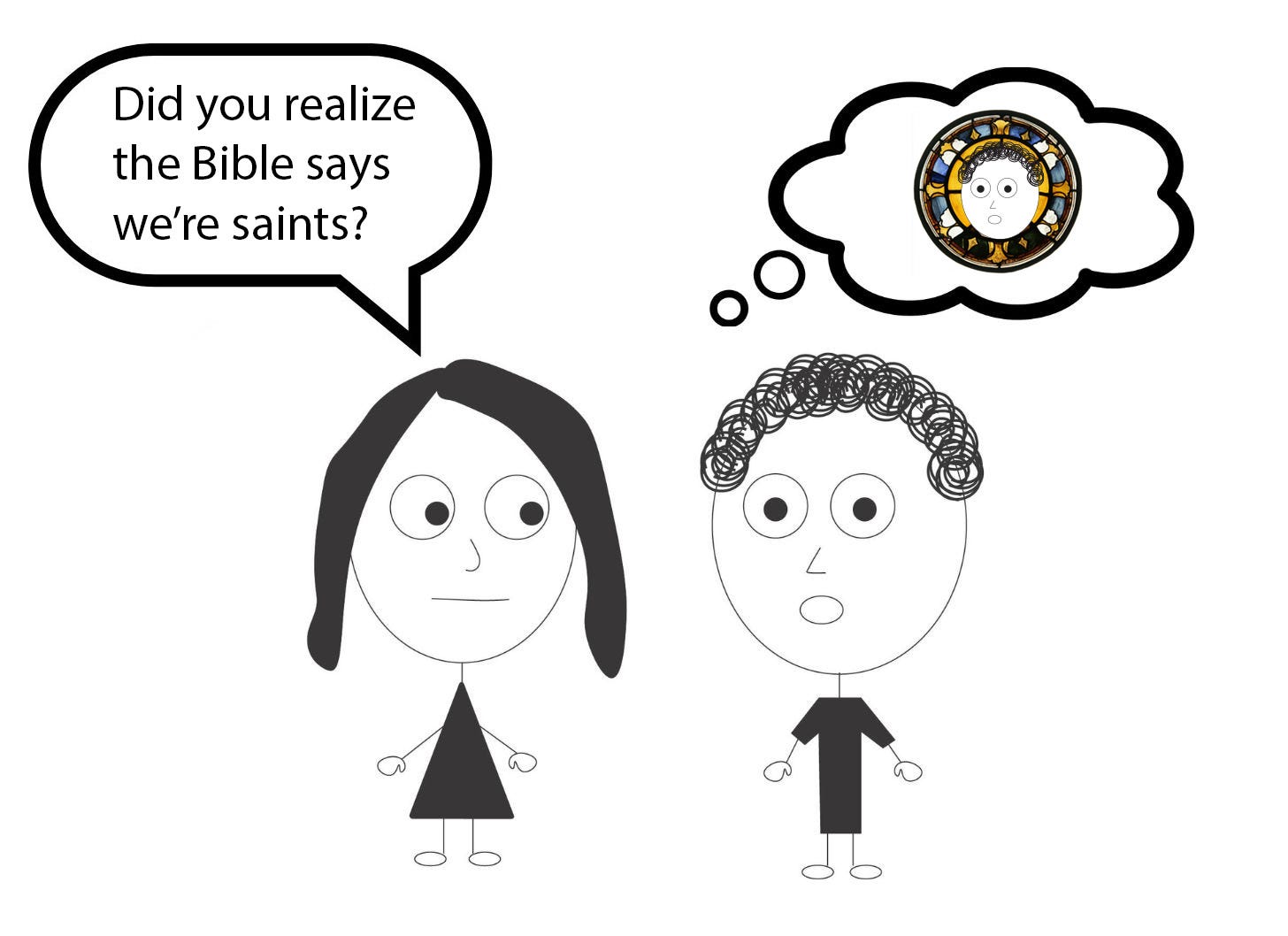
Saint.
What comes to mind when you hear that word?
For many, it’s an extremely moral person. Maybe someone who made great sacrifices for the good of others. Possibly someone who performed miracles. You might picture a person with a bright halo around their head, like in a medieval painting or a stained glass window.
While those ideas may contain some truth, they also miss something. In fact, there are few words in the Bible that are more commonly misunderstood than saint.
Takeaway: In the Bible, the word saints refers to all Christians, not just those who are unusually holy. But whichever word we use to refer to ourselves, living up to our calling as believers can feel impossible. This is especially true because our understanding of grace causes us to question ourselves the moment we try to do anything to grow spiritually. Fortunately, I think there’s a way forward.
I went to the Catholic Church as a child. And although I admittedly took little interest in Rome’s teachings, I absorbed the idea that a saint was, in some sense, extra-holy. Many others, Catholic or not, have done the same.
In my late twenties, I started going to a church outside of my familiar tradition. Here, the pastors pointed out something I’d never noticed before: every time the New Testament uses the word saints, it refers to all people who trust and follow Jesus, not just those who are unusually spiritually accomplished.
In the New Testament, the word “saints” appears 67 times. “Saint” in the singular form shows up once, with a plurality of believers again in view: “Greet every saint in Christ Jesus” (Philippians 4:21). In every instance of the word, as best I can tell, it refers to ordinary believers. Not those with extra-special spiritual accomplishments or character.
But maybe that understanding can also be taken too far. Because Christians, believers, saints, disciples, followers of Jesus, practitioners of the Way—whatever we choose to call ourselves—we aren’t ordinary.
We know this because Jesus calls us light of the world (Matthew 5:14). He also says we’re his own body (Ephesians 4:12). As such, our lives should be radiating joy, peace, and goodness, among other extraordinary qualities (Galatians 5:21). We’re even supposed to be able respond with love to those who treat us with hatred and cruelty (Matthew 5:43).
At which point a lot of Christians have to quietly admit: I’m not sure that’s what I’m experiencing.
We’ve all been plagued by the feeling, as one pastor describes it, that we’re “second-rate Christians.”1 And at this point we might have come full circle. We could start to think, “maybe a saint is an extra-holy person after all, and I’m not one.”
Of course, we’d also like to change. To grow. In our best moments, we Christians really do want to live our lives fully for the Lord.
But how are you going to pull yourself up by your bootstraps and make that happen?Especially if many of your previous attempts to grow spiritually have led to disappointment? Especially when you’ve heard 101 sermons assuring you that trying to pull yourself up by your bootstraps is exactly the problem?
In other words, how can you choose to grow in a faith that’s grounded in the unearned gift of God’s grace? The moment you try to do something to make yourself more moral, more holy, more saintly—whichever word you choose—don’t you risk doing the exact opposite?
I want to talk about the “grace versus works conundrum,” as it applies to spiritual growth. I personally think the subject is more confusing than many Christians acknowledge. We have a lot of tidy explanatory phrases at the ready, but less clear-eyed consideration on this subject than we probably need. And I think this very confusion stifles a lot of believers who genuinely want to grow.
And I also think there’s a way forward.
By that, I mean there’s a way—by God’s grace, of course—to real and lasting Christian growth. And you don’t have to quit your job or become a monk or ignore your kids to experience it.
One short post at a time, I’ll do my best to explain.
Whitney, Donald S. Spiritual Disciplines for the Christian Life. Page 37.